
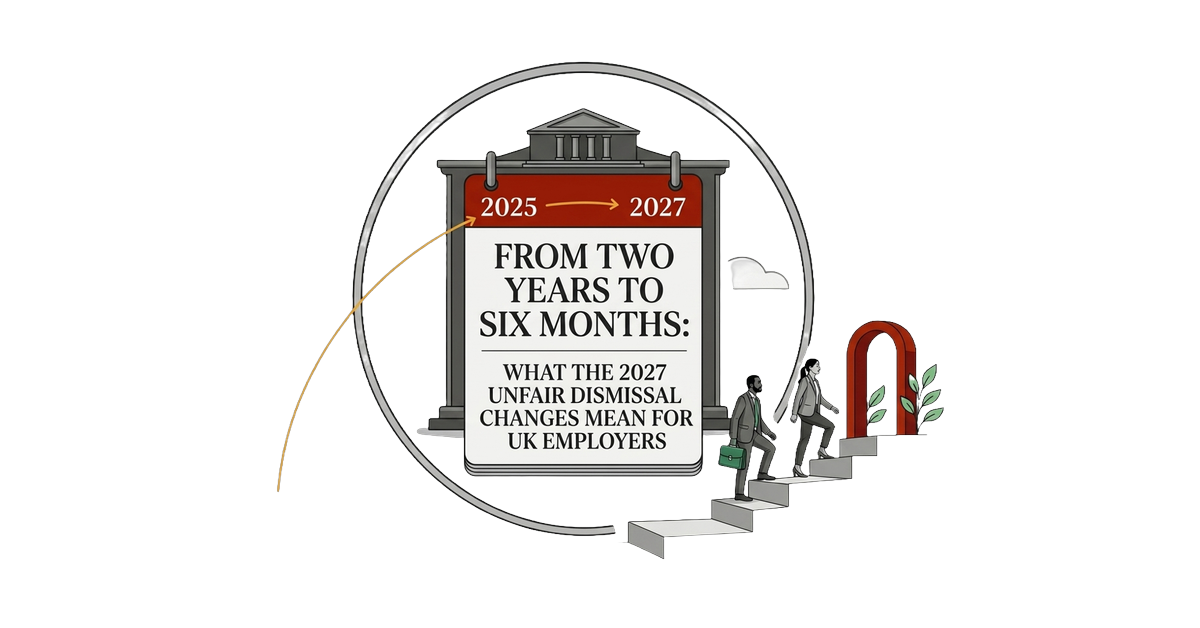
UNFAIR DISMISSAL: THE CHANGES UK EMPLOYERS MUST KNOW BEFORE 2027
Most UK employers know that unfair dismissal exists. Far fewer understand what it requires of them, and even fewer are prepared for what changes in January 2027. This article covers both.
Under s.98 ERA 1996, employers have the obligation to dismiss employees only for fair reasons. Those potential reasons include:
All of the above are fair reasons to dismiss an employee, but regardless, employers have always had a duty to demonstrate that they have taken all reasonable steps to ensure a fair procedure that justifies a dismissal outcome, and the role of HR professionals has always been to implement policies (and actually follow them) to protect the relationship between employer and employees.
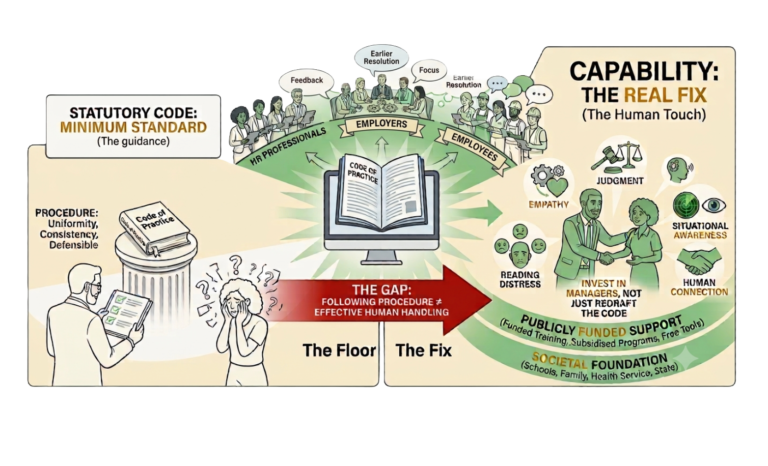
Although it is not legally binding, those policies should establish a fair procedure in line with the ACAS Code of Practice on Disciplinary and Grievance Procedure as a minimum standard.
What will change?
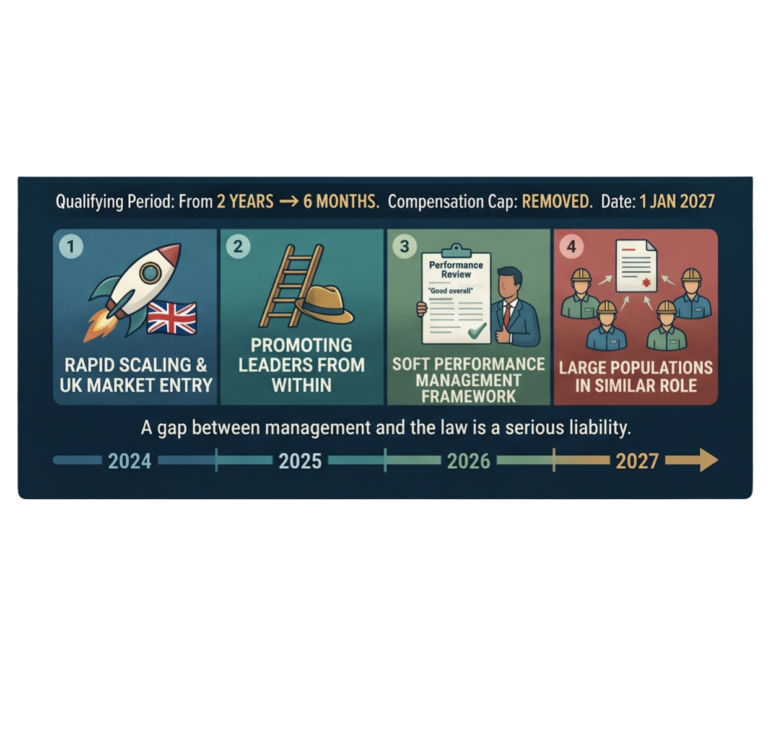
Starting 1 January 2027, the qualifying period for employees to claim unfair dismissal will drop from two years to six months, and the compensation cap of the lower of either £123,543 or 52 weeks’ gross pay will also be removed. Employees with six months of service by that date will immediately gain protection with no compensation limit. This includes all employees with continuous employment from at least 1July 2026.
That means any employee you hire today will already have six months of service when the law comes into effect, and your organisation needs to get ready to manage those changes as soon as possible, particularly those organisations that have relied on the two-year qualifying period to avoid addressing the lack of fair procedures.
How will these changes impact the way companies operate when exiting employees?
The combined effect of these two changes is significant. A shorter qualifying period means more employees can bring a claim earlier, and the time to assess whether an employee is a good fit for the organisation without process constraints is substantially reduced, which in some cases might clash with the fact that six months is not enough to understand the employee’s performance. The removal of the compensation cap means the financial exposure for getting it wrong is now, in principle, unlimited. In this scenario, performance and probation mismanagement have, then, an unlimited risk for employers that must be managed with rigour.
Previously, an employer could weigh the risk of an unfair dismissal claim against a known maximum liability for a fairly long period of time (two years). That calculation no longer works. A successful claim can now result in a compensatory award based on actual loss, which for a senior employee or a long-running case could far exceed the old cap. The financial risk of a poorly handled dismissal has materially increased overnight.
This changes how organisations need to think about exiting employees at every stage, not just at the end of a formal process. In practical terms:
Conclusion
ERA 2025 does not introduce a new concept of Unfair Dismissal, but it significantly changes who holds that protection, how early they hold it moving forward, and what it can cost when a dismissal does not stand up to scrutiny. We still need to see the impact of these changes in tribunal claims and the approach taken by Judges, particularly in terms of claimants’ compensation.
For employers who have quietly relied on the two-year window as a safety net to keep going, that net is gone. For employers who have always followed good processes, this is primarily a prompt to check that their managers are equipped to deliver it consistently from a much earlier point in the employment relationship.
The practical question is not whether your organisation understands the law. It is whether your performance and probation framework is built to deliver it, whether your managers and leaders have the skills and culture to have difficult conversations early, whether your People function uses data to identify capability gaps, take action, and anticipate challenges before they become liabilities, and whether AI can meaningfully support the management of those challenges at scale.
One Comment
Comments are closed.