The Most Exposed Organisations to 2027 Unfair Dismissal
The law is changing unfair dismissal for every employer, but four types of organisations are far more exposed than the rest, and the risk each of them carries is the same: inconsistency that cannot withstand scrutiny.
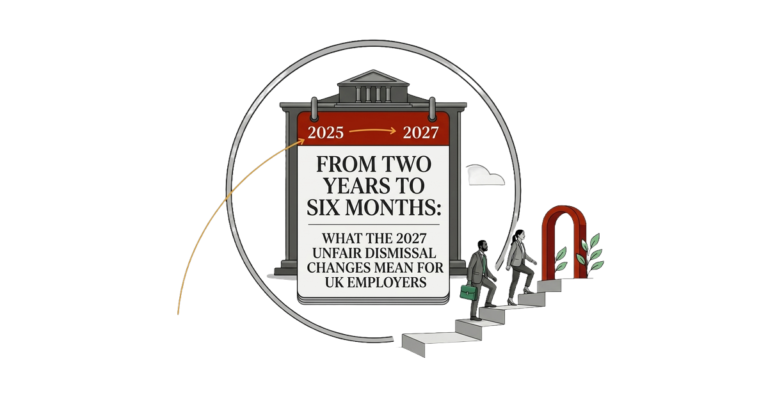
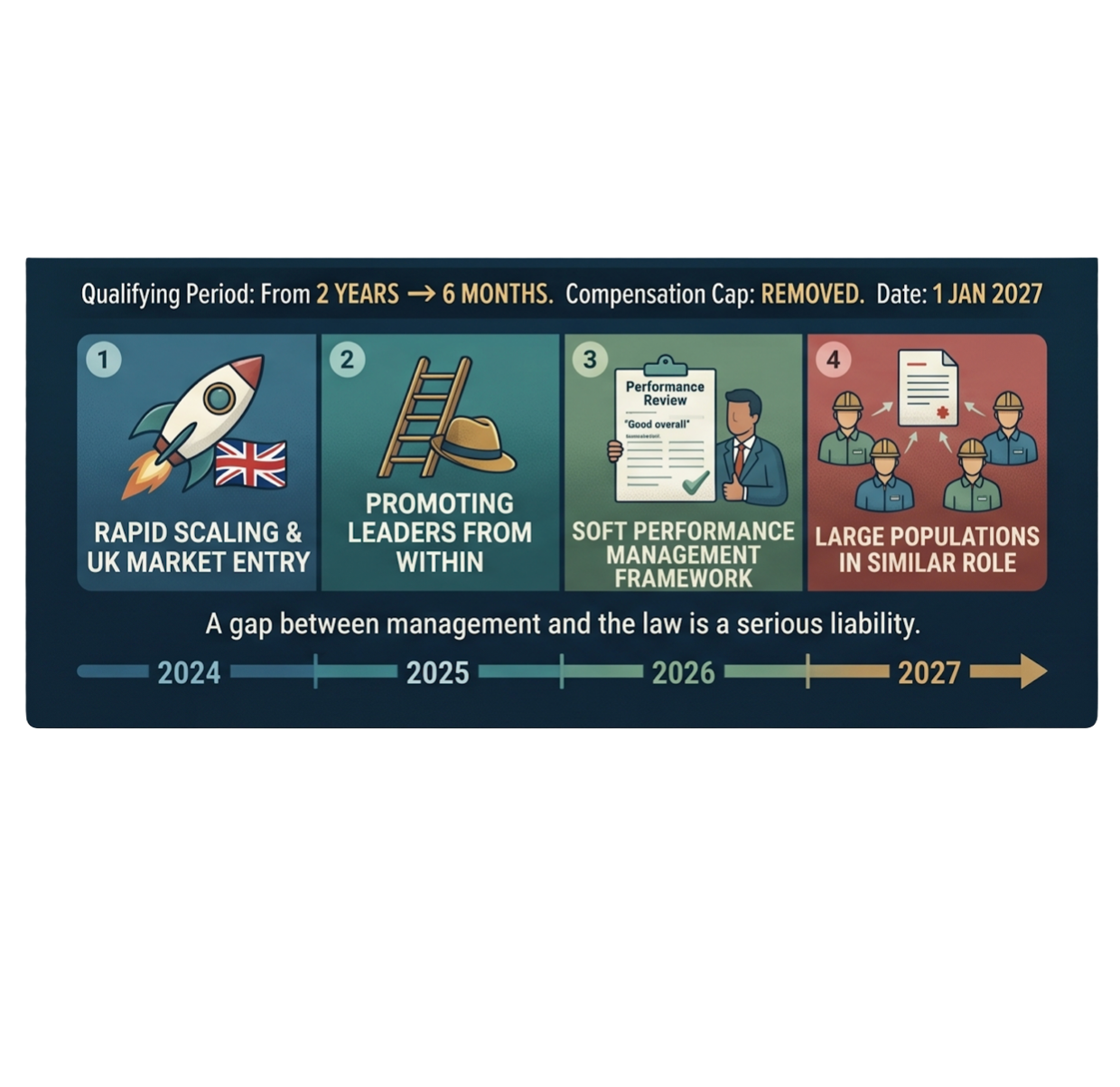
From 1 January 2027, the qualifying period for unfair dismissal drops from two years to six months, and the compensation cap is removed. In practice, any employee you hire from July 2026 onwards will already be protected by the time the change lands. I set out what the changes are, and what they require of employers, in an earlier article. This one is about a different question: who is most exposed?
Because the change does not land evenly, every employer carries more risk than before, but four types of organisations carry far more than the rest.
What unites them is not bad intent. It is a gap between how they manage people and what the law now requires, and that gap becomes a liability far earlier in the employment relationship than most of them realise.
1. Organisations scaling rapidly or entering the UK market
Fast-growing companies and international organisations expanding into the UK often bring their home-country approach to employment with them. In many markets the relationship works very differently: dismissal procedures are lighter, documentation less rigorous, and HR involvement in exits more limited.
An organisation whose leadership culture was shaped outside the UK, and has not fully adapted to UK jurisdiction, carries a specific risk. As headcount grows quickly, the gap between hiring pace and HR infrastructure becomes a serious liability.
Line managers are often hired ahead of the policies and guidance they need, and HR capacity rarely grows at the same rate as the workforce it is meant to support.
The answer is not to slow hiring. It is to build the HR infrastructure at the same pace as the headcount, and to make sure every manager operating in the UK understands the legal framework they are working within from the moment they take on their first direct report.
2. Organisations that promote leaders from within
Promoting from within is one of the strongest signals an organisation can send to its people. It says that performance is recognised, that loyalty is rewarded, and that growth is possible without leaving. Done well, it builds retention, engagement, and a culture that attracts and retains talent for the right reasons.
The risk is not having internal promotion per se; the risk is what follows it. The organisation celebrates and moves on, without equipping the new leader to manage performance from day one. A manager who does not understand probation, does not document performance conversations, or does not know when to escalate to HR is not a bad manager. They are an unsupported one.
And the legal weight of line management now sits on that person much earlier. A poorly handled probation review, or an undocumented concern that leads to dismissal, will not be defended by the fact that the manager was new to the role. With a six-month qualifying period, expectations need to be explicit from day one, documentation needs to start earlier, and HR and Senior Management need to support managers through it before it becomes a legal problem.
3. Organisations with a soft performance management framework
You know who you are. Ratings that cluster around “meets expectations.” Managers who give warm feedback in the review and raise the real concern informally over coffee. PIPs that exist in the policy but rarely in practice, or even worse PIPs that exist with no SMART goals. A culture where being liked matters more than being honest and fair.
That approach has always created people problems and made it hard to calibrate performance fairly across similar roles. Now it is about to create legal ones too. If you cannot show documented performance conversations, clear expectations for both behaviour and output, and a genuine opportunity to improve, you and your organisation are exposed. Not eventually. From much earlier than you might currently think.
4. Organisations with large populations of employees in similar roles
Organisations with large numbers of people performing similar roles face a risk that stays invisible until it becomes a claim: inequity of treatment.
It is rarely intentional. It emerges from inconsistency across line managers, each making a reasonable-sounding decision that, viewed across the whole cohort, forms a pattern. One employee has their targets adjusted through a difficult period; another does not. One receives retraining when they fall behind; another is placed on a plan for the same gap. One is given flexibility around their working pattern; another is refused.
Without a clear, criteria-based rationale for why those decisions differed, each variation becomes a potential comparator argument at tribunal. The question is not simply whether you documented the conversation. It is whether the standard, the support, and the opportunity to improve were applied consistently and fairly across everyone performing the same role.
This is where framework design matters more than any individual process. The framework needs to define what good looks like for the role, what support the organisation commits to providing, under what criteria adjustments to expectations are justified, and how those decisions are made and recorded.
This is not to create bureaucracy, but to ensure that every deviation from the standard has a documented and defensible rationale. In high-volume, similar-role environments, the risk is not in the individual decision. It is in the pattern those decisions create across the workforce.
The common thread
These four organisations look very different, but the exposure is identical: inconsistency, undocumented decisions, and a process that cannot withstand scrutiny. Whether you are scaling ahead of your HR infrastructure, promoting managers without equipping them, running a soft performance culture, or managing large cohorts in similar roles, the 2027 changes turn the same weakness into the same liability, and they do it far earlier in the employment relationship than before.
Getting this right is not about updating a policy document in December 2026. It is about clear frameworks, managers who can hold honest conversations early, consistent application across the workforce, and HR in the room before a formal process is the only option left. The organisations that navigate this well will be the ones that treat it as a structural change to further improve business performance rather than a mere HR procedural one.