Why a new ACAS Code Won’t Prevent the Next Tragedy
One-size-fits-all failed at HM Treasury, an employer with every resource imaginable, and it will fail employers with fewer resources until we invest in the thing that is underfunded: capability.
That, for me, is the uncomfortable lesson sitting underneath a case that has rightly disturbed the profession, and it is the reason I am wary of where the response is heading.
For anyone who has not followed the case, in brief: a young employee at HM Treasury died last year, shortly after being called to a meeting about an anonymous complaint made against them. According to evidence given at the inquest, which is still ongoing, they were given no notice of what the meeting was about or that a senior manager would be present, were not allowed to bring anyone with them, were not told whether their job was at risk, and left in acute distress.
The Treasury has since said it is reviewing its disciplinary procedures and giving managers additional training. Because the inquest is open and the full picture is not yet established, I will not speculate beyond what has been reported, and nothing here is a judgement on any individual. If you want to read a full article on what has been reported, you can read the fuller reporting in The Guardian.
Days after that evidence was reported (yesterday), ACAS opened a consultation on its Code of Practice on Disciplinary and Grievance procedures on 30 July. For readers outside HR, the Code is the statutory guidance that sets out how employers are expected to handle discipline and grievances fairly. Employment tribunals take it into account when deciding whether a process was fair and can raise or lower compensation by up to 25% where it has been followed poorly or ignored.
The eight-week consultation of the new code draft, open until 23 September 2026, is aimed at encouraging earlier and more informal resolution, with closer attention to wellbeing. The timing has understandably been read as a response to the case, and there is a deeper reason it should be. On the reported facts, much of what happened appears consistent with the current Code. The Treasury may have followed the guidance, and it still was not enough.
ACAS’s instinct to reach out to HR professionals, employees and employers for a review of the Code is a good one, and the consultation is welcome. But if a revised Code becomes the whole of our answer, we will have tidied the paperwork and missed the point.
The failure was not the absence of a procedure
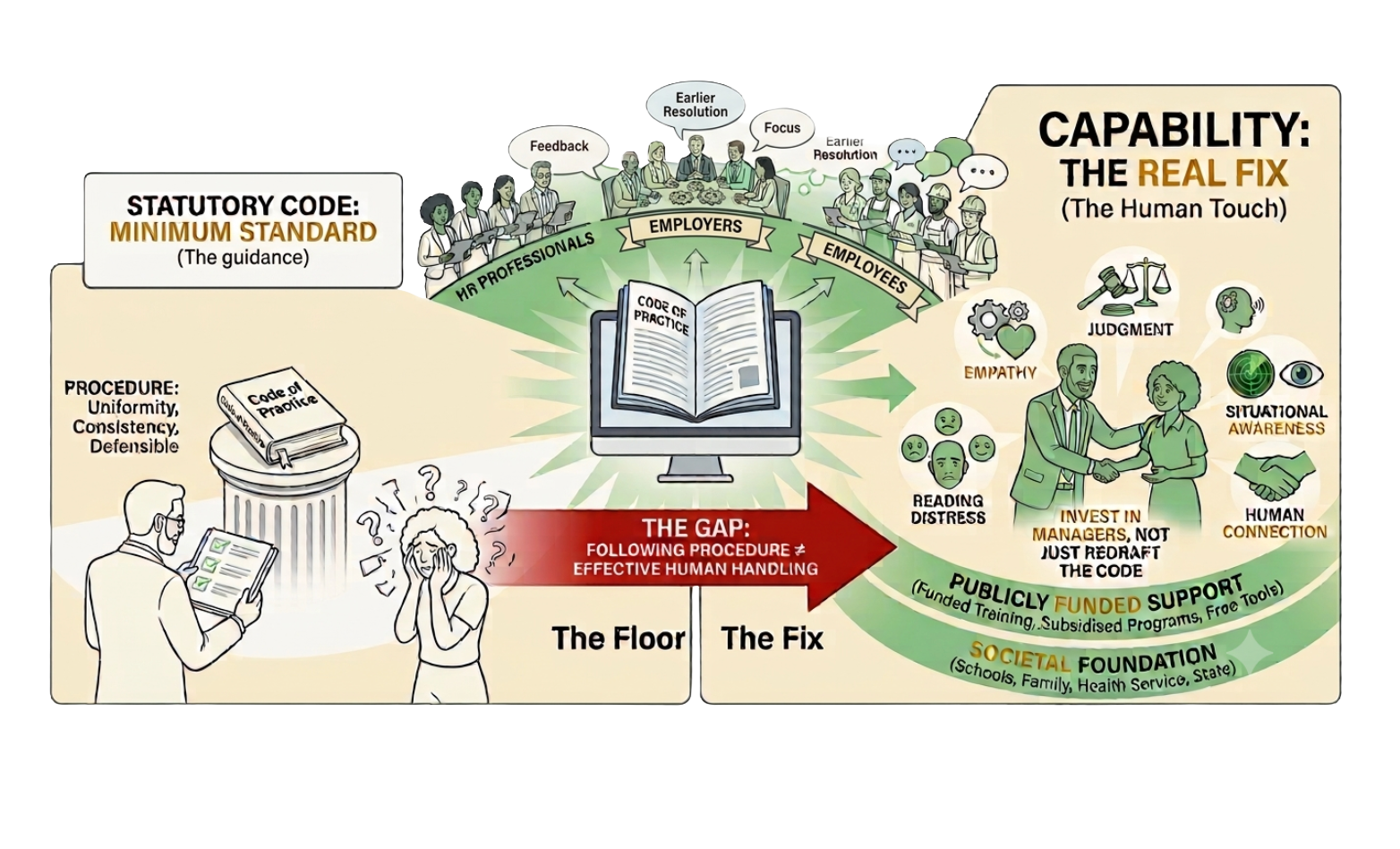
The ACAS Code of Practice sets a minimum standard of reasonable behaviour and fair procedure. It is guidance, not binding law, though tribunals weigh it heavily when they judge whether an employer acted fairly. That distinction matters here, because on what is known, this case does not look like a failure to follow the right procedure. It looks like a failure in the human handling that no procedure can legislate and no Code can reach.
You cannot write empathy, judgement, or reading of distress into a Code. You cannot mandate the instinct to pause, to explain what happens next, or to notice that the person across the table has stopped hearing anything after the words “anonymous complaint”. Those are not clauses. They are capabilities: the situational awareness to see what is happening in the room and to respond to it.
This is where the difference between uniformity and judgement becomes the whole argument. A procedure gives a manager the steps and the order to take them in. It is uniform by design, the same for everyone, and that consistency is worth having. But uniformity cannot tell a manager how to read the specific person in front of them, or what to do when the moment calls for something the script does not cover. Judgement is exactly that: recognising that even a preliminary, informal meeting before any investigation has formally begun can come across to someone as a threat to their whole livelihood, and adapting to that in the moment.
A Code can be followed to the letter and still fail, because following the steps correctly is not the same as weighing whether this application, to this person, on this day, was the right one.
And this is why resources were never the missing piece. The Treasury did not fail for want of policies, lawyers, or budget. It had all three. If an organisation that is well-resourced and heavily governed can still get the human part wrong, the problem was never going to be solved by better wording or more detailed guidance. Uniformity can be written down and handed out. Judgement must be built in people, over time, through training, coaching, and experience. That is a gap in capability that no redraft of the Code can close.
One Code, very different capacity to meet it
Now, let us widen the lens and move away from the HM Treasury case. A Code applies in identical terms to a bank and to a café with six staff. The expectation is the same for both organisations, but the capacity to meet it is not.
A small business has no HR function, no learning and development team, and often no manager who has ever been trained for a conversation like this one. Whole sectors such as hospitality, retail, social care, and small charities run on margins that leave nothing for capability building, and they employ millions of people, frequently those with the least protection to begin with. Raising the standard through a Code, without funding the ability to meet it, does not spread good practice evenly. It exposes the employers who can least afford to fail, and it gives their employees weaker handling.
Of course, employment law and tribunals already half-concede this, because what counts as “reasonable” flexes with the size and resources of the employer. But a person in crisis does not experience a smaller crisis because the employer is small. The stakes in the room are identical.
I have seen similar disparities when advising women facing discrimination in the workplace through the Pregnant Then Screwed Advice Line. Those who work for big corporations still face discrimination but are more likely to get substantial compensation. However, those who work for small businesses face structural discrimination due to employers’ lack of resources and basic understanding of maternity protection and good practices. It leaves them more exposed to discrimination and less equipped to advocate for themselves.
The workplace cannot carry what it did not create
There is a wider truth underneath this that the profession finds hard to say out loud. Employers hold a real and serious duty of care, and they must meet it. But mental health is not, and cannot be, the sole responsibility of the job market. It is co-owned by our schools, our families, our health service, and the state.
That shared responsibility starts long before anyone reaches the workplace. Our schools and universities shape both sides of this: the human skills a manager brings to a difficult conversation, and the resilience each of us draws on in one.
Employers increasingly expect people to arrive work-ready and resilient, and that expectation is not unreasonable. But resilience is grown over years, through education, support and experience. It cannot be switched on at an induction, and it is never a substitute for handling people well. If we want capable managers and people equipped for working life, that investment has to begin in education, not land on the workplace at the point of crisis.
When we ask the workplace to become the place where a lifetime of unmet need is finally noticed, assessed, and put right, we ask of employers, and of managers, something they were never built to provide.
A manager in a disciplinary meeting is not a clinician. They do not have, and often cannot access, the person’s history, and they cannot always hold a crisis that the wider system failed to catch upstream. Treating the employer as the last line of defence is itself a systemic failure, and the smallest organisations are the least able to be that line.
This is not a case for employers doing less. It is a case for everyone doing their part and for being honest about whose part is whose.
Spare a thought for the person who delivered the news
In the commentary that follows cases like this, the person who suffered is given a full and deserved humanity, and the people who ran the meeting are given almost none. We should be careful here.
It is neither fair nor accurate to reduce a death to a single conversation, to blame a manager for following the rules as they understood them, or to expect them to have foreseen an outcome that no one could reliably foresee.
We should not assume that anyone will react well to hard news, and we should be just as slow to assume they will react badly. Hindsight is not insight. It is easy to see what might have been done differently after the event, and far harder to see it in the moment. The managers in these rooms carry the weight afterwards, often alone, and a profession serious about wellbeing owes it to them as much as to the people they manage.
What taking responsibility actually looks like
If the lesson is not simply a better Code, then what is it? It is investment in the one thing that actually failed: capability. And because the smallest employers cannot fund that alone, the investment has to be public and shared.
Concretely, that means funded, accessible manager training in handling difficult conversations, rather than leaving each employer to buy it or improvise. It means subsidised capability programmes for employers, particularly small and medium ones, built into the skills and apprenticeship funding that already exists rather than invented from nothing. It means ACAS and the professional bodies making practical tools freely available, so a manager aware of their need to improve those skills has something more to reach for than a policy document.
A Code of Practice is a floor, a minimum standard, and capability is the fix. And a floor that no one has been resourced to reach is not much of a floor at all.
The measure of a disciplinary process is not whether it is defensible on paper. It is whether two human beings can go through it, both shaped by systems larger than either of them, and come out of it whole. Updating the Code will let us say we acted. Investing in capability and sharing the responsibility honestly is how we would actually mean it.
This article touches on suicide. In the UK, the Samaritans can be contacted free at any time on 116 123, or by email at jo@samaritans.org.